

Live updates: OpenAI President expected to testify Monday
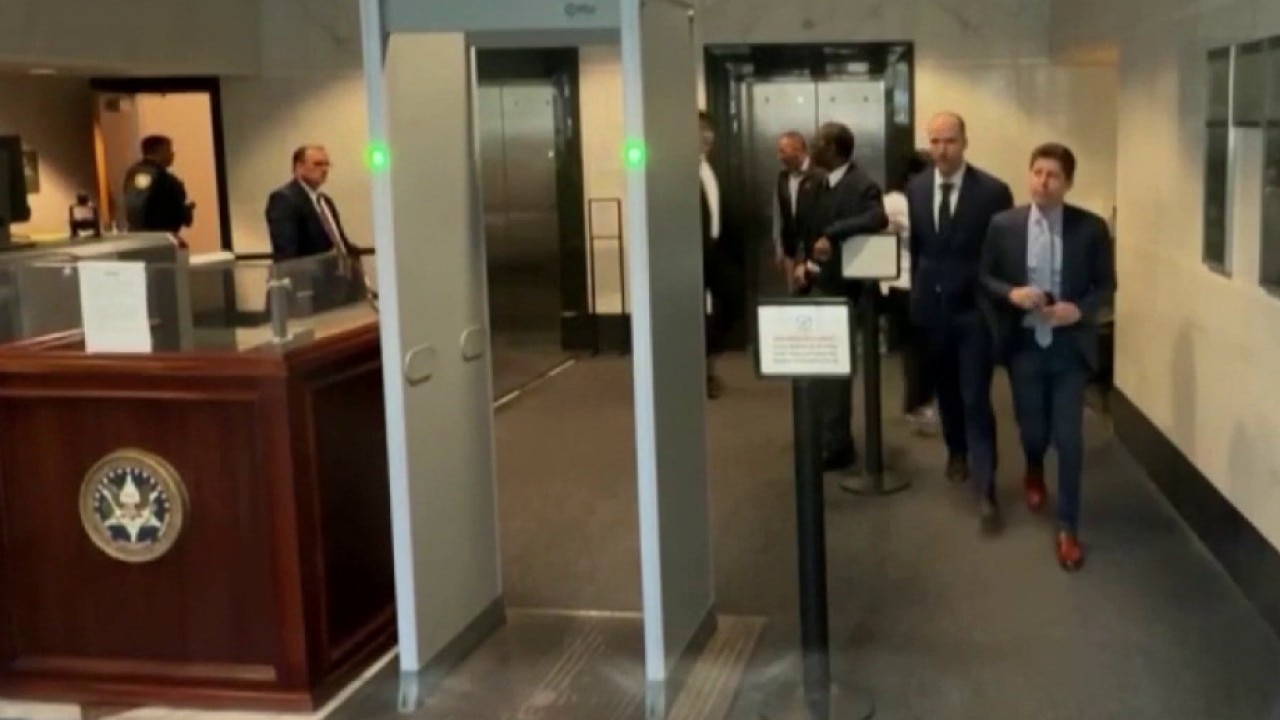
OpenAI's Sam Altman and Greg Brockman arrive at the Oakland Federal Courthouse Thursday to hear continued testimony by Elon Musk and Musk's Head of Family Office Jared Birchall.
Musk testified again Thursday in his lawsuit against OpenAI's Altman and Brockman, maintaining that the non-profit's funds were diverted to the for-profit OpenAI subsidiary, bringing Altman and Brockman unwarranted financial benefits.
OAKLAND, Calif. - Elon Musk's attorneys say they plan to call OpenAI's President Greg Brockman to take the witness stand on Monday, May 4, as the trial continues. Judge Yvonne Gonzalez Rogers said last week that Musk, who testified for three days during the first week of the trial, could still be called back to the stand.
Musk's attorneys said they do not plan to call Sam Altman as one of their witnesses.
During the meeting with attorneys Friday morning, the judge reviewed jury instructions with attorneys for all parties. Musk, Altman, and Brockman were not in the courtroom at Oakland's Federal Building.
Elon Musk took the stand Tuesday, Wednesday, and Thursday in the landmark trial that pits the world’s richest man against Sam Altman, a fellow OpenAI co-founder he accuses of betraying promises to keep the company as a nonprofit dedicated to humanity’s benefit.
What is the Musk-Altman trial about?
The backstory:
The trial centers on the 2015 birth of the ChatGPT maker as a nonprofit startup primarily funded by Musk before evolving into a capitalistic venture now valued at $852 billion. It started Monday and is expected to last about three weeks.
Musk, who invested about $38 million in OpenAI from December 2015 through May 2017, gave his account of OpenAI’s early years, recounting how he lost confidence that Altman would keep it a nonprofit. Questioned by his lawyer, Steven Molo, Musk said by late 2022 he was concerned Altman was trying to "steal the charity."
"It turned out to be true," Musk said on the witness stand, wearing his usual courtroom attire of a black suit and tie.
Altman, OpenAI’s CEO, was in attendance at the federal courthouse in Oakland, California, although he was not scheduled to testify on Wednesday or Thursday.
What is OpenAI saying?
Lawyers for OpenAI have rejected the allegations brought in Musk’s civil lawsuit and said there were never promises that the company would remain a nonprofit forever. The company has argued Musk’s legal challenge is aimed at undercutting OpenAI’s rapid growth and bolstering Musk’s xAI, which he launched in 2023 as a competitor.
KTVU will be inside the courthouse in Oakland each day and will bring you live updates here.
Musk v. Altman - Live update from federal courthouse, Day 4
Another day of contentious exchanges as Elon Musk took the stand Thursday in the Musk v. Altman trial at Oakland's Federal Courthouse.
Live Updates: Day 5 - May 1, 2026
10:30 a.m.
Judge Yvonne Gonzalez Rogers met with attorneys at 10 a.m. Friday to handle various motions and objections surrounding the Musk v. Altman trial. A vigorous discussion between the parties over the wording of jury instructions took up a large portion of the meeting.
Musk's attorneys gave the judge the names of the remaining witnesses.
Sam Altman, the co-founder of OpenAI, is not on the plaintiff's list.
- Monday: Musk's attorneys say they plan to call Stuart Russell, a UC Berkeley expert witness, and OpenAI President Greg Brockman to testify.
- Tuesday: Greg Brockman (continued) and several corporate videos
- Tuesday or Wednesday: Shivon Zilis, former employee Rosie Campbell, and a non-profit expert.
Note: Friday, May 1, the jury is excused. Judge Gonzalez Rogers has scheduled a meeting at 10 a.m. Friday with the attorneys to discuss the case and any issues that arise.
The jury will return to court to resume the trial at 8:30 a.m. on Monday, May 4. The list of witnesses who still wait to be called includes expert witnesses UC Berkeley professor Stuart Russell and OpenAI President Greg Brockman.
Live Updates: Day 4 - April 30, 2026
1:25 p.m.
Judge Yvonne Gonzalez Rogers has dismissed the jury early to speak with attorneys about various objections and motions.
No court on Friday, so the next hearing is scheduled for Monday, May 4, at 8:30 a.m.
11:50 a.m.
The judge called for another 20-minute break and will be returning shortly.
Second witness: Jared Birchall, head of Musk's family office. Initial questions revolved around his knowledge of donations made by Elon Musk to OpenAI and confirming documents showing contributions that were larger than other donors.
Birchall testified that he helped coordinate communications between Musk and the legal team when there was a question with the California Attorney General's office about OpenAI modifying its structure.
Musk's attorney: "What were the nature of your concerns?"
Birchall: "The concerns were (efforts) to further modify the nature of OpenAI and extract profit from the non-profit for the benefit of the for-profit."
OpenAI's attorney asked Birchall about Musk's charitable donations, and said that Musk was benefiting by taking a tax write-off on his OpenAI donations.
Birchall: "It is part of the consideration when making charitable donations."
OpenAI's attorney is pressing Birchall on Musk's donations to OpenAI: monetary charitable donations of $38 million, rent payments for leasing space in San Francisco's Pioneer Building office space, and Teslas which Musk gifted to Altman and others.
10:45 a.m.
Musk's attorneys returned to questions about the timing of Musk's lawsuit. Musk said he did not think the 2019 Microsoft investment of $1-billion in the capped, for-profit OpenAI subsidiary was a breach of the charitable trust. Musk said he also didn't think Microsoft's $2-billion capped-profit investment in 2021 in the OpenAI for-profit arm was a breach of the charitable trust. At the time, the OpenAI for-profit arm was under the OpenAI Foundation, which remained a non-profit.
Musk said it was only later that he felt the for-profit had "looted" the OpenAI non-profit.
Musk: "You can't take a supermajority of the nonprofit's value and move that to a for-profit."
11:00 Before Musk finished his testimony, Judge Yvonne Gonzalez Rogers gave several strong direct orders and warnings to Musk.
One was about making legal statements. Musk had said the OpenAI attorney had been asking "leading" questions. The judge stopped the questioning and stated:
Judge: "Let's remind everyone you're not a lawyer. And you've never taken a class in evidence."
Musk: "I did take Law 101."
Judge: "You are not a lawyer."
Judge: "You don't have statements on the law, at least not in this court."
Also, before allowing him to step down from the witness stand, the judge warned Musk he must not make sweeping apocalyptic statements about AI. Musk had testified that "if we want to make a lot of robots we have to make sure it's safe and not a Terminator situation," referring to the Terminator movie. His attorney asked what the worst-case scenario was and Musk replied, "that AI kills everyone." The judge told Musk he was not to make any such statements in the future. The judge allowed Musk to leave the courtroom. He left the courthouse.
10:30 a.m.
Back in court for more Elon Musk testimony today. Tesla CEO and OpenAI co-founder was on the stand for about an hour and a half. OpenAI defense attorney Bill Savitt started with cross-examination this morning, asking Musk about the development of his own for-profit xAI artifical intelligence entity founded in 2023. Questioning the timing of creating his own competing AI company and suing OpenAI. Also asking again about Musk's support for OpenAI becoming a for-profit entity.
Musk's attorney, Steven Molo, followed with questioning focused on a September 2017 email (exhibit 158) from Sam Altman to Musk highlighting the early negotiations over the founding of OpenAI, with Altman stating, "i [sic] remain enthusiastic about the non-profit structure." Musk also testified that the non-profit and open source mission of OpenAI was the reason he donated his money, time, reputation.
Musk: "Everyone agreed that this was going to be a charity..."
Later, during questioning:
Musk's attorney: "Were your continued contributions affected by this?"
Musk: "Yes. That was the whole basis to my donation of 38 million dollars, my name..."
Musk: "I continued to fund OpenAI as a result of these commitments to keep OpenAI a nonprofit."
Live Updates: Day 3 - April 29, 2026
1:40 p.m.
The judge dismisses the jury. The defense attorney indicated there would likely be an hour more of cross-examination for Musk on Thursday, and then Musk's attorney would be able to follow up with questions.
1:30 p.m.
Following the second 20-minute break of the day, the attorney for Altman, Brockman, and OpenAI resumed questioning, with continued contentious exchanges between Musk and the attorney.
Musk said he had difficulty answering the "yes or no" questions, because he felt he needed to add context and tried multiple times to insert other comments. The defense attorney ended up repeatedly reading sections of Musk's previous deposition statements made under oath, so the jury could hear Musk's responses.
At the end of the Day 3 testimony, the defense attorney pressed Musk to identify whether OpenAI posed any greater safety risk than other AI companies, including Musk's own X-AI. During the exchanges, the attorney asked Musk:
Def. Attorney: "Do you think a for-profit AI company creates a safety risk?"
Musk: "Yes, I think it creates a safety risk."
Def. Attorney: "Does X-AI suffer from that safety risk?"
Musk: "Yes."
Def. Attorney: "Do you know what a safety card is?"
Musk: "Why a card?"
Def. Attorney: "Have you ever looked at OpenAi's public documents website to see what it is doing with respect to safety?
Musk: "I don't think it has credibility."
1 p.m.
Musk's testimony continues with questioning now from Bill Savitt, defense attorney for Altman, Brockman, and OpenAI. The exchanges were often contentious, with Musk giving lengthy answers and judge instructing him to answer a simple "yes or no." Musk said questions were not simple and tried to elaborate multiple times.
Musk's financial support:
The defense attorney Savitt began by raising questions about Musk's financial support of OpenAI. Savitt referenced deposition statements from September 2025. The defense attorney noted that Musk cut off quarterly $5-million donations to OpenAI in May 2017, but in the 2023 tweet claimed that he had donated $100-million. The defense attorney read from the deposition:
Musk: "In strict monetary terms I contributed $38 million."
Def. attorney: "So it wasn't true that you donated anywhere near $100 million to OpenAI?"
Musk: "I was mistaken."
The defense attorney also asked Musk about multiple emails where Musk discussed with OpenAI about creating a for-profit arm to raise money:
Musk: "As long as the for-profit is in service to the non-profit, it is not breaking the promise."
Musk's emails discussing OpenAI becoming a for-profit arm
The defense attorney presented multiple email exhibits showing Musk corresponding with OpenAI about the need to raise more money and Musk's openness to a move to "for-profit" status.
Def. attorney: "In 2017, you started having discussions with the others about a potential for-profit structure?"
Musk: "I remember we had discussions."
At one point, during testimony, the defense attorney told Musk to answer questions simply.
Musk: "Your questions are not simple, they're designed to trick me."
Def. Attorney: "You're a bright guy. I'm asking you questions that have yes or no answers."
The judge later pressed Musk multiple times to answer "yes or no" to questions about whether Musk remembered being open to creating an OpenAI for-profit arm.
Musk replied, "Yes."
Musk's interest in bringing OpenAI and OpenAI staff to Tesla's AI team
The defense attorney also asked Musk about emails Musk wrote after he withdrew OpenAI funding in mid-2017. The exhibit emails indicated Musk wanted Tesla to acquire OpenAI in order to compete with Google.
Def Atty: "You proposed that OpenAI should attach itself to Tesla?"
Musk: "I'm not sure what you mean by attach."
The defense attorney pressed Musk on email exchanges where Musk said he lost confidence in OpenAI and wanted to rebuild AI within Tesla. The defense attorney noted that Musk stated in emails that he would actively try to "move people from OpenAI to Tesla" and asked one ally to stay active within OpenAI to "keep info flowing."
"Tesla is the only path to be a counterweight to Google," the defense attorney read from a Musk email exhibit.
11:30 a.m.
The third day of the Musk v. Altman trial began with Elon Musk returning to the witness stand. His attorney addresses defendants' accusations that Musk didn't bring a lawsuit until he had his own competing X-AI company. Musk testifies the reasons why he filed a lawsuit later:
Musk's attorney: "Why didn't you bring this lawsuit in 2018?"
Musk: "In 2018 they had not yet breached the charitable trust. Thinking someone might steal your car is not the same as someone stealing the car."
Musk's attorney: "Why didn't you bring this in 2020?"
Musk: "Same reason."
Musk's attorney: "Why did you only sue after the 2023 Microsoft deal was announced?"
Musk: "The nonprofit had been looted in 2023."
Musk: "My concern was Microsoft would own artificial generative intelligence that was developed by the charity."
The Source: The Associated Press, witness testimony.