

Trump administration fires at least 15 immigration judges in Bay Area

SF immigration judges say firing could impact some 25,000 cases
Some 15 Bay Area immigration court judges have been fired so far this year by the Trump administration's Department of Justice. Two of them, Jeremiah Johnson and spoke out Tuesday, saying tens of thousands of cases that were on their dockets, could now face long delays and backlogs.
SAN FRANCISCO - San Francisco immigration judge Jeremiah Johnson was having a great day at work.
"I was having the best day ever, actually," he said.
He did not have a detained docket that morning, leaving him plenty of time to spend on his master calendar hearings. He handled a case from Honduras. A Mayan mother from Guatemala. He found a dollar on the street and bought himself a large chai latte. In the afternoon, he joked with colleagues and chatted with his supervisor about how to be more efficient.
And then, people's phones and computers started blowing up.
He and four other judges in San Francisco all received termination letters on Nov. 21, ending their years of service with no explanation.
He wanted to print or take a photo of his firing to preserve it, but "just then my system shut down."
A colleague walked by.
"Hey, you're off the website," Johnson recalled him saying.
And then, he had to leave.
"I packed up my office," he said. "I rode my bike home. And I didn't have time to bring all my stuff home."

Now-fired San Francisco immigration judges, Jeremiah Johnson and Shuting Chen, sit down for an interview with KTVU on Tuesday, Dec. 2, 2025.
15 judges in Bay Area
Aside from Johnson, four other immigration judges in San Francisco were fired that day.
They are: Amber George, Louis Gordon, Shuting Chen and Patrick Savage.
Earlier this year, since President Donald Trump took office, San Francisco's top immigration judge, Loi McClesky, Shira Levine, Chloe Dillon, Elisa Brasil, Ila Deiss, Roger Dinh and Jimi Vigil were also fired, according to reports by NBC Bay Area, KQED, Mission Local, the San Francisco Chronicle and the San Francisco Standard.
The National Association of Immigration Judges also confirmed the seven judges were fired, but did not confirm them by name.
In Concord, at least three immigration judges have reportedly been fired. They include: Kyra Lilien, Florence Chamberlain and Roberta Wilson.
There are now nine immigration judges left in San Francisco and seven in Concord, according to the U.S. Department of Justice.
These firings will only add to the immigration court backlog already dominant in the United States, immigrant rights advocates point out. There are 3.4 million immigration cases pending in the system, according to TRAC Immigration, an immigration collection clearinghouse at Syracuse University.
"Well, the immigration court backlog across the country is several millions of cases, and in San Francisco it's among the highest, if not the highest," said Central Legal de la Raza attorney Abby Sullivan Elgen. "So now we have a decimated bench."

San Francisco immigration judge details backlog with firing
San Francisco immigration judge Jeremiah Johnson was fired on Nov. 21. He details the backlog of cases that will follow.
100 judges across U.S.
According to a spokesperson for the National Association of Immigration Judges, a professional organization and union of judges, no one really tracked the firing rates before this administration, making it hard to compare whether the Trump administration is firing more immigration judges than in past years.
But a spokesperson for the association did say that, on average, about 5% of immigration judges typically left each year, either because of firing, retiring or quitting.
Since Trump took office, the immigration judge association said about 100 immigration judges have been fired or pushed out, whittling the number down from 715 immigration judges across the country to roughly 600 – a 16% drop.
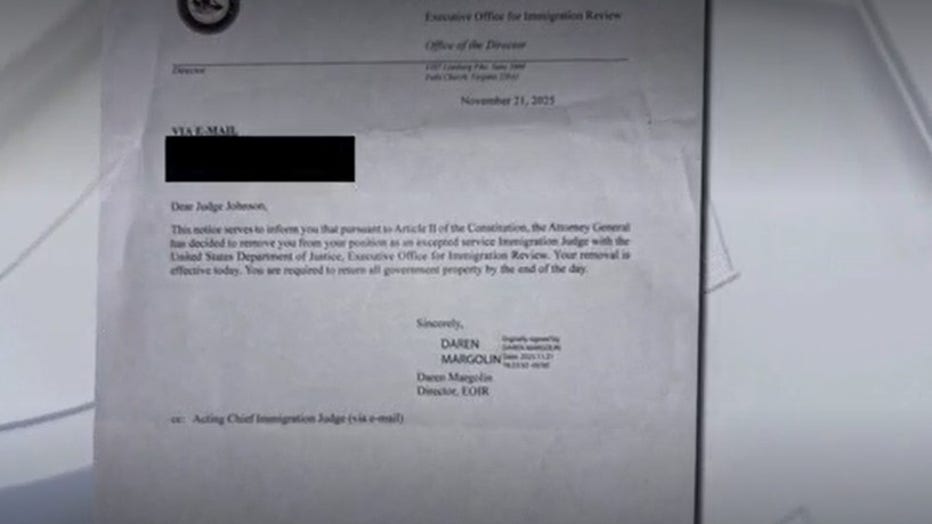
A copy of a San Francisco immigration judge termination letter obtained by KTVU. Nov. 21, 2025
‘Systemic bias’
The Executive Office for Immigration Review, which is an agency of the U.S. Department of Justice, states that all judges have a legal, ethical, and professional obligation to be impartial and neutral in adjudicating cases.
If a judge violates that obligation by demonstrating a "systematic bias" in favor of or against either party, the agency said it is obligated to "take action to preserve the integrity of its system."
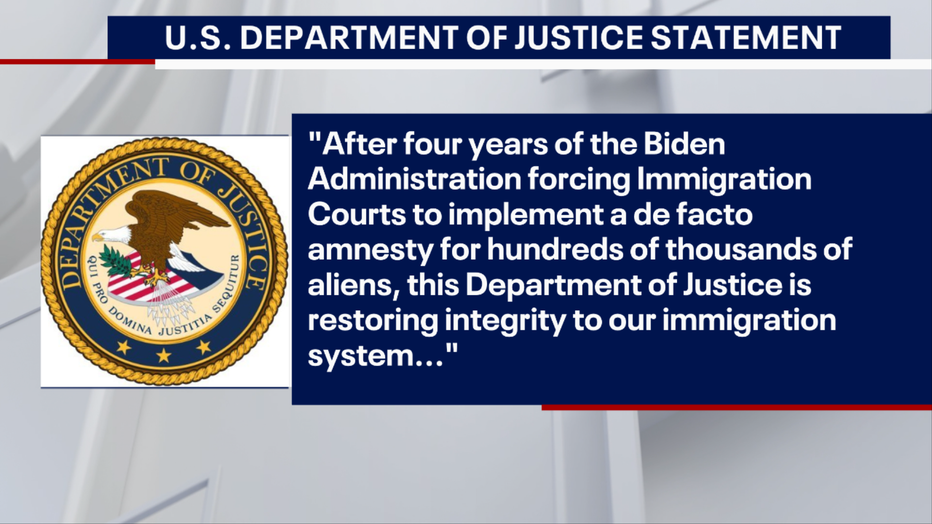
In an email, a DOJ spokesperson said: "After four years of the Biden Administration forcing Immigration Courts to implement a de facto amnesty for hundreds of thousands of aliens, this Department of Justice is restoring integrity to our immigration system and encourages talented legal professionals to join in our mission to protect national security and public safety."
The spokesperson would not answer follow-up questions in an interview, but did say that the DOJ is now hiring, directing people to a website that states the government is hiring "deportation judges" to "help write the next chapter of America."
The pay range is from about $160,000 to about $210,000 a year with a 25% base-pay recruitment incentive for first-time federal employees in San Francisco, Concord, Sacramento, Los Angeles, Santa Ana, Chelmsford, Mass.; and New York, where eight immigration judges were fired on Monday.

The DOJ is advertising for deportation judges. DOJ website
Grant rates
There was no reason given to Johnson or Chen for their firings.
Each received a four-sentence email saying their services were no longer needed, along with a letter.
Johnson, a Trump appointee in 2017, said he was never given a reason for his termination.
"I never had any complaints of bias," Johnson said. "I'm happy to sit down with my superiors, to talk to whomever to tell me why I was fired."
What stood out among the 15 judges fired in the Bay Area, was that their "grant rate" of asylum seekers was well above the national average of about 58%.
Of the 15, one judge fired had a grant rate of 72%, and one judge had a grant rate of 35%, according to Syracuse's TRAC Immigration. All the others fired had grant rates that were either near or above the 90% approval rate.
Johnson's grant rate was about 89%. Like 13 out of 15 of the fired judges, most of his asylum seekers were from India; mainly Sikhs from Punjab.
Dream job dashed
Shuting "Ting" Chen, a former San Francisco immigration judge of three years, was also fired on the same day that Johnson was.
She had also been having a great day.
As the daughter of immigrants from China, becoming an immigration judge three years ago was her calling, her "dream job."
"It made me realize that the law could transform lives," Chen said from her home in San Francisco. "And it also gave me an opportunity to sort of give back to this country that has given me so much through its immigration system."
But while she was sitting on the bench, a termination email popped up on her screen during the middle of someone's testimony.
She read that she was fired and cried from the bench.
"Everybody just sat there kind of stunned," she said. "I left the courtroom and within two minutes, my robe was off for the last time."
Twenty minutes later, she said, all access to her computers and files had been revoked.
Chen's grant rate was 90.9%.
But as she explained it, she wasn't rubber-stamping people's entry into this country.
"The way the law is written, it does not allow every single person who's afraid for their lives to come into the country," she said. "There are various requirements that you have to be able to show, not just that you're afraid to return to your home country, but various other factors. And I saw my job as implementation and application of the law fairly and with due process. It was never about letting people in or keeping them out."
'Attack' on the system
She explained that grant rates are extremely complicated.
Whether or not someone is approved for asylum depends on whether they are detained, what country they are from, the changing law, and the global political climate that might affect a country's individual standing.
"I want to say about grant rates is that if the department had a problem with my grant rate, and they felt that my decisions were unsound, then they should have appealed more of my decisions," Chen said. "I would say the Department of Homeland Security only appealed, probably fewer than 5% of my asylum grants."
Chen said it's wrong to simply focus on grant rates.
She has colleagues in the Bay Area and across the country who have had low grant rates, and they've been fired, too. One of her judicial colleagues in San Francisco who was fired had been a former ICE employee and military veteran.
"What I'm seeing is an attack on the immigration court system as a whole," she said.
She said she left behind 4,000 cases. Estimating that her four fired colleagues also left about that many, Chen said, "the five of us together maybe had like 25,000 pending cases on the docket."
That means a legal assistant will now spend time rescheduling and notifying all the parties that their cases likely won't be heard until after 2029.

Firing of immigration judges
The recent firings of several long-serving immigration judges in the Bay Area and nationwide have left the bench severely understaffed. KTVU's Gasia Mikaelian spoke about the issue with Abby Sullivan, immigrant rights attorney with Centro Legal de la Raza in Oakland.
Ripple effects
Both Chen and Johnson worry that with so many immigration judges fired, the law won't be adhered to.
"If you fire judges, then you stop having courts," Johnson said. "If you stop having courts, you stop having the rule of law."
The Immigration Nationality Act demands that immigration judges must preside over hearings to remove immigrants from the United States.
He also worries about whether his slot will be filled and who it will be filled with.
"If you want a strong border and a secure country, you need experts in immigration law hearing those cases," he said. "Congress should be asking those questions. I think the American people and the taxpayers should be asking those as well."
What's next
Johnson has now been out of work for two weeks, and he said he's trying to remain optimistic while looking for new job opportunities.
He's been an immigration attorney and an asylum officer before, and he feels he could find a job there, or possibly for the Department of Homeland Security.
Chen also said she plans to look for a job.
But she gets very emotional when talking about finding new work.
"I need to find a new job, and I'm exploring some opportunities," she said. "But I mean, quite frankly, this job was like finding a soulmate for me. Like it, it really felt like I was made for it, and it was made for me. And I think many of my colleagues felt that way about it. Like this was our dream job. We loved it. It was our calling. And so, I think I have some opportunities now to explore. But I quite frankly feel like I left a piece of myself on that bench. I don't know that I'll ever recover."